
How to Wear a Travel Pillow on a Plane Without Fighting the Seat
Position the pillow around the movement you need to control, not around a single universal orientation rule.
Different pillow shapes are designed to make contact in different places. Use the product's intended support zone, your seatback, and your normal sleeping direction to find the correct position.

Put the Pillow On in the Order the Design Requires
Avoid starting with a rigid rule such as always wearing the opening in front or always rotating it backward. Begin with the product's support geometry and your main movement problem.
Identify the Intended Contact Area
Look for chin support, taller side walls, an asymmetric support section, or a rear pad and place that feature where it can address your main movement.
Sit Fully Against the Seat
Position the pillow only after your back and head are in the posture you expect to use. This reveals whether rear padding changes your position.
Adjust Closure or Inflation Gradually
Tighten or inflate only enough to create stable contact. More pressure does not automatically create better support.
Let the Head Move Naturally
Relax toward your normal sleep direction and confirm the pillow contacts you before the movement becomes large.

Start by Finding the Intended Support Zone
A front-heavy, side-heavy, wraparound, or extended design may need a different orientation. Look at the geometry before copying how another traveler wears a different pillow.
Start With the Support Zone the Pillow Was Designed to Use
There is no single correct way to wear every travel pillow. Some open-front designs are intended to support the sides and back of the neck, while others place more structure under the chin. Wraparound products may rely on a front closure, and directional pillows can be rotated toward the side where support is needed. The product shape should decide the starting orientation. For a closely related guide, see neck pillow for airplane.
Before tightening anything, place the pillow loosely and let your head relax for a moment. Notice which direction it naturally moves. Then position the support where it can limit that movement without forcing the neck into an unusual angle. This approach is more reliable than following a blanket rule that every U-shaped pillow should always face the same direction. For another practical angle, see sleeping upright. For this specific topic, review pillow for sleeping on plane.
Check What Changes When the Seat Reclines
A pillow can fit differently after even a small recline. Rear padding, headrest wings, and shoulder position all change the space available around the neck.
Recline check
- Rear thickness: confirm the pillow does not wedge the head forward once you settle into the seat.
- Side walls: make sure the pillow still contacts the jaw or neck rather than slipping below the shoulder.
- Closure: recheck tension after your posture changes.
- Accessories: put headphones, glasses, hood, and eye mask on in the order you will use them.
Let the Seatback Share the Work
A pillow should work with the seat rather than create a second seatback in front of it. If the rear cushion is thick, check whether it fills an empty gap or simply pushes the head forward. If the seat has adjustable wings, use them before tightening the pillow because they may reduce the amount of side support you need from the accessory. You can also explore neck pillows for airplanes.
Recline also changes the contact pattern. Even a small change in seat angle can alter how much weight rests on the back of the head versus the jaw or side of the neck. After reclining, recheck the closure and support position instead of assuming the setup will feel the same. Small adjustments usually work better than starting with maximum tightness. A focused guide on travel pillow for side sleepers adds useful detail.
Recognize When the Position Is Wrong
A poor position usually shows up as slipping, forced posture, missing contact, or pressure in the wrong place. These signs are more useful than copying a photo.
| What you notice | Likely issue | What to change |
|---|---|---|
| Head still drops forward Missing front contact | The support zone is not under or around the chin. | Reposition or use a shape designed for forward support. |
| Head pushed forward Too much rear bulk | Pillow and headrest are stacking behind the head. | Reduce rear padding or change orientation if the design allows. |
| Pillow slides down Weak contact / loose closure | The support is not held at the intended height. | Adjust closure, inflation, or position without over-tightening. |
| Ear or temple pressure Accessory conflict | Side walls are sharing space with headphones or glasses. | Lower or reposition the pillow, or choose a lower-profile shape. |
Different Shapes Need Different Positioning Logic
Once you know the support pattern, the wearing position becomes easier to reason about.
U-Shaped and Wraparound
Keep the intended side walls aligned with the neck and jaw, then use the front opening or closure as designed. Check rear thickness against the seat.
- Center before tightening
- Recheck after recline
- Test forward and side movement
Side-Support and Body Styles
Rotate or place the main support section toward the direction you actually lean. These designs often depend more on correct orientation than symmetric pillows.
- Choose your dominant lean side
- Follow attachment instructions
- Confirm it stays stable during movement
Reposition Instead of Enduring a Bad Fit
If you wake with the pillow pressing into your jaw, ear, or shoulder, treat that as a positioning problem to investigate rather than something to tolerate. Loosen the closure, rotate the support, reduce inflation, or move the rear section until the contact feels more balanced. A travel pillow is adjustable equipment, not something that has to stay in one fixed orientation for the whole trip. See this related travel neck pillow on Amazon.
The same rule applies when you switch activities. A position that works for sleeping may be inconvenient while eating, reading, or using a laptop. It can be easier to loosen or remove the pillow temporarily and reset it later. Using the product in phases keeps it from becoming another item you fight with during the flight. Another relevant resource is sleeping on long flights.
Travel Pillow Options With Different Wearing Positions
The catalog includes shapes that sit differently around the neck and seat. Use the steps above first, then inspect each product's shape, closure, instructions, and listed dimensions.
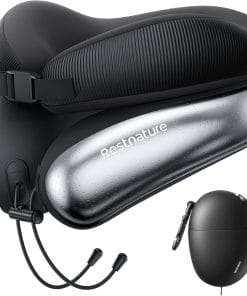
Neck Pillow for Traveling, Travel Pillows for Airplanes, Adjustable Neck Pillow Airplane Travel Essentials – 2 Layer Patented | Inflatable Air Loop & Memory Foam for 360° Ergonomic Support

Dream Valley® Neck Travel Pillow, Memory Foam Travel Pillow for Airplane, Portable Roll-Up Neck Pillow with Cooling Inner Fabric, 360° Ergonomic Support, No Head Bobbing, Charcoal Gray

Travel Pillow, Memory Foam Neck Pillow with Ergonomic 360° Support, Travel Neck Pillow for Airplanes, Compact Design for Plane, Car & Office Travel Essentials, Gray

jiaao Neck Travel Pillow Memory Foam 360° Neck Support Pillows for Airplane | Ergonomic Neck Pillow for Long Flight, Airplanes, Cars & Trains, Kit with Eye Mask, Earplugs and Storage Box
Use Contact and Seat Fit to Confirm the Position
If the pillow only works when you hold an unnatural posture, the issue may be the shape or fit rather than the wearing technique.
