Memory Foam
Foam cores can hold moisture and may have different cleaning limits from a removable fabric cover. Follow the product instructions for the core itself.
CHECK: COVER VS CORE

Start with the care label and material, because foam, inflatable, and fabric-filled products should not be treated the same way.
Start with the care label and material, because foam, inflatable, and fabric-filled products should not be treated the same way.
Separate removable covers from internal cores, use the listed care instructions as the authority, dry every part fully, and inspect valves, seams, or closures before storing the pillow between trips.
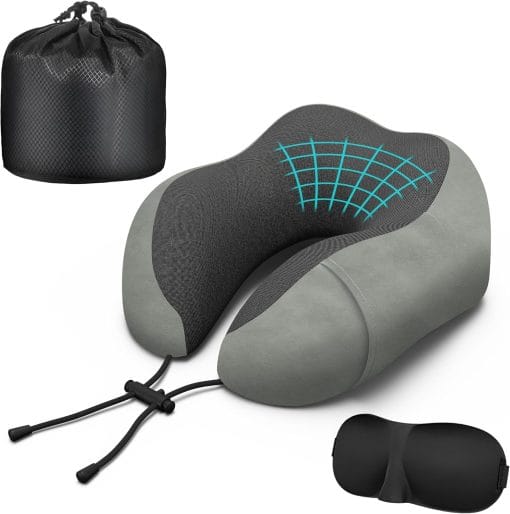
Do not use one cleaning method across every travel pillow. Read the product care instructions and separate outer textiles from internal support materials before choosing water, detergent, washing, or drying methods.
Foam cores can hold moisture and may have different cleaning limits from a removable fabric cover. Follow the product instructions for the core itself.
Air bladders, valves, and seams require attention to moisture, abrasion, and inflation hardware. Surface cleaning may differ from textile care.
Fabric-filled or mixed designs can use machine-washable textiles, fixed fill, removable inserts, or multiple materials. Treat each component according to the listing.

A listing may say machine wash because the cover is washable while the foam or internal bladder requires a different method. Identify every removable part before cleaning the whole product.
Many travel pillows combine materials that should not be cleaned in the same way. A removable polyester or cotton-blend cover may be washable even when the memory foam core underneath is not intended for a machine cycle. An inflatable product may have a textile surface around an air bladder and valve that need a different cleaning approach. Treating the whole pillow as one material can create unnecessary risk. For this specific topic, review memory foam vs inflatable.
Start by identifying which parts can be removed without forcing zippers, seams, valves, or inserts. Then read the care instructions for each component. If the listing gives instructions only for the cover, do not assume those instructions apply to the internal support material. Product-specific guidance takes priority over a general travel-pillow routine. See this related travel pillow on Amazon.
The safest general routine is to identify, separate, clean, dry, inspect, and only then store. Product-specific instructions always override a generic sequence.
A pillow can look clean and still be unsuitable for storage if moisture remains inside folds, foam, fabric layers, or around a valve. Thick materials need more drying time than a thin removable cover. Packing too early can trap dampness and lead to odor or a stale feel by the next trip. Give every component enough time to dry before reassembly. You can also read about structured support. For a closely related guide, see antimicrobial travel pillowcase.
Air circulation usually matters more than rushing the process with high heat. Follow the stated drying method and avoid inventing shortcuts that the product instructions do not support. For inflatable items, make sure the valve and surrounding surfaces are dry before closing and storing. For foam products, check the core rather than judging dryness only from the outer surface. Another relevant resource is inflatable travel pillow guide.
Use the table as a checklist of what to verify, not as a replacement for the product label.
| Material / part | Main care question | What to verify |
|---|---|---|
| Removable cover Textile care | Can the cover be machine-washed or hand-washed separately? | Temperature, detergent, drying, zipper closure. |
| Memory foam core Moisture control | What cleaning method is allowed for the foam itself? | Spot cleaning, water exposure, drying time. |
| Inflatable bladder Surface + valve | How should the surface and valve be cleaned without trapping moisture? | Valve position, seam condition, air-drying. |
| Fiber / hybrid body Whole-item care | Can the full pillow be washed, or must components be separated? | Machine cycle, drying method, removable inserts. |
Storage is part of maintenance. A clean pillow can still develop odor or deformation if it is packed damp, compressed for too long, or stored with a damaged valve or zipper.
Check seams, folds, foam, and inner surfaces before packing the product away.
Find small problems before the next trip instead of discovering them at the airport.
Some pillows are designed to compress; others are better stored with less long-term pressure. Follow the product guidance.
Open the pillow, inspect odor or damage, and confirm that inflation, closure, or cover functions still work.
Before the pillow goes back into a closet or luggage organizer, check the parts that are easy to ignore during travel. Look at seams, zippers, closures, straps, and inflation valves. Small damage is easier to notice when the product is clean and dry than when you are preparing to board a flight. A simple inspection can prevent discovering a problem at the moment you need the pillow. A focused guide on hygiene pillowcase for travel adds useful detail.
Store the product in the way intended for its material. Some inflatable pillows are designed to remain deflated between trips, while foam products may not benefit from long periods of extreme compression. If a storage pouch is included, make sure the pillow is dry before using it. The goal is to start the next trip with a clean, functional product rather than a repair task. You can also explore memory foam travel pillow.
These catalog examples may use memory foam, inflatable bladders, synthetic fill, removable covers, or mixed construction. Open each listing and follow the product-specific care instructions before cleaning.

Good maintenance is less about aggressive cleaning and more about using the correct method, drying completely, and catching small issues before the next trip.