Window Seat
A side surface may reduce one direction of movement, but you still need to manage forward drop, seatback bulk, and any gap between the head and wall.
CHECK: SIDE CONTACT + RECLINE

Start with the seat and your head movement before adding more travel accessories.
Start with the seat and your head movement before adding more travel accessories.
A better setup comes from solving the biggest movement or space problem first. Use seat position, support direction, accessory fit, and packing limits to choose what belongs in your travel kit.
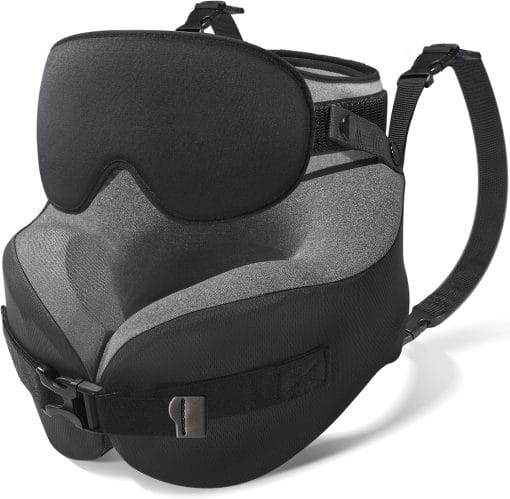
Window, middle, and aisle seats create different opportunities and restrictions. Your seat does not decide the product for you, but it changes what surfaces and space are available for support.
A side surface may reduce one direction of movement, but you still need to manage forward drop, seatback bulk, and any gap between the head and wall.
You usually have fewer side surfaces to lean against, so a pillow with balanced side support or a stable wraparound shape may matter more.
Easy access can mean more interruptions and fewer stable side surfaces. Prioritize a setup that does not depend on leaning into another surface.

A travel pillow can look supportive in isolation but behave differently against a headrest. Look at the rear profile, side height, and any strap or closure that depends on the seat.
Airplane comfort starts with the space around you. Seatback shape, recline, headrest wings, armrest position, and the location of the window all influence how a pillow or support strap will work. A travel accessory cannot create room that the seat does not provide, so it helps to decide where your head can realistically rest before choosing a product. A useful related topic is red-eye flight. A focused guide on red eye flight pillow adds useful detail.
Window-seat travelers may have a side surface available, while aisle passengers often need a setup that keeps the head closer to the seatback. Middle seats usually offer the least room for sideways movement. These differences do not make one accessory universally better, but they explain why the same pillow can feel useful in one seat and awkward in another. More detail is available on long-haul flight. For this specific topic, review travel pillows for long flights.
The most useful setup addresses the first movement that wakes you or makes you uncomfortable. Watch what your head does when you stop actively holding it upright.
A neck pillow supports the area around the neck, jaw, or chin. A head strap or seat-attached stabilizer works differently by limiting how far the head moves relative to the seat. Some travelers need one of those functions much more than the other. Treating them as separate problems makes it easier to decide whether a single accessory is enough or whether a combined system makes sense. Another relevant resource is neck pillow for airplane.
This also prevents overbuilding the setup. If your main problem is a small amount of side lean, a supportive pillow may be sufficient. If your head repeatedly falls away from the seat, stabilizing the head itself may matter more. Adding every available accessory can increase heat, pressure, and setup time without improving the one issue that actually interrupts sleep. See this related airplane travel pillow on Amazon.
Neck pillows, head straps, eye masks, and blankets play different roles. Keep each item tied to a specific need instead of treating them as a single comfort bundle.
| Tool | Primary role | Dependency / limitation |
|---|---|---|
| Neck pillow Head/neck contact | Adds support around the neck, chin, sides, or rear depending on shape. | Fit and seatback geometry can change the result. |
| Head strap Head stabilization | Uses the seat or headrest to limit head movement. | Requires a compatible attachment point and acceptable pressure. |
| Eye mask Light control | Reduces visual disturbance without supporting the head. | Can conflict with glasses, headphones, or high pillow sides. |
| Blanket Warmth / coverage | Addresses temperature rather than head movement. | Adds packed volume and may need separate storage. |
Several travel accessories occupy the same area around the ears, temples, hood, and seatback. Check that the pieces can coexist before you bring all of them on a long flight.
A long flight is a poor time to discover that a strap does not fit the headrest or that a pillow interferes with your headphones. Try the setup at home using a chair with a firm back. Check how the pillow closes, how quickly you can put on an eye mask, and whether you can reach the buckle or valve without removing everything. For a closely related guide, see sleeping on long flights.
The goal of a pre-trip test is not to reproduce an airplane seat perfectly. It is to find obvious conflicts before travel. If the setup takes several minutes, requires constant readjustment, or feels crowded when all accessories are worn together, those problems are likely to become more noticeable in a narrow cabin. Simplifying before the trip can be more useful than adding another comfort item. You can also explore airplane comfort accessories.
These live catalog options show different support approaches used for upright travel. Use the seat and movement checks first, then inspect each product page for dimensions, materials, straps, closures, and current seller information.

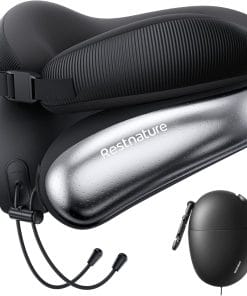
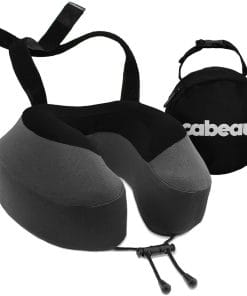
A smaller setup that solves the main movement problem is usually easier to position, pack, and repeat on future trips.