
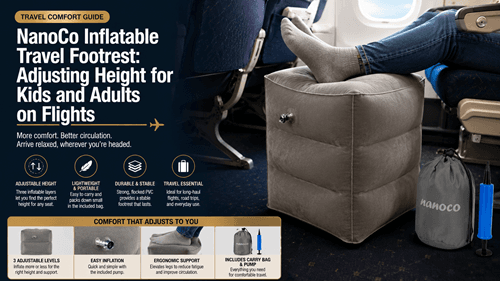
NanoCo Inflatable Travel Footrest is useful only when the airline permits the setup and the inflated height fits the seatwell without blocking movement, seat structures, or another passenger’s space. Kids and adults need different heights, so the advantage of an inflatable design is the ability to test partial inflation rather than treating maximum height as the default.
Families should check the operating airline’s current policy before travel because rules for inflatable footrests and child comfort devices vary. This guide focuses on height, pump use, seating position, packing, and comfort checks; it does not override crew instructions or airline-specific restrictions.
How To Adjust NanoCo Inflatable Travel Footrest By Seat And Traveler
Measure the vertical gap from the floor to the lower legs in a normal seated position. The goal is to reduce dangling or uncomfortable knee angle, not to raise the feet as high as possible.
Inflate in stages. A partially filled cushion can be softer and lower, while a fully inflated one may become too firm or tall for a small seat pitch. Check stability each time you add air.
Keep the valve and pump accessible so adjustments can be made without moving the device into the aisle. Deflate and stow it whenever crew instructions require the floor area to be clear.
Height, Pump Use, And Seatwell Positioning
Start With The Lowest Useful Height
An inflatable leg rest height should support the feet without lifting the knees into the tray table or forcing the hips backward. Add air gradually and reassess after several minutes.
Adults with longer legs may need only a small lift, while shorter travelers may prefer more height. Maximum inflation is not automatically the most comfortable setting.
Keep The Cushion Inside Your Footwell
An airplane foot support cushion should remain in your own floor area and should not extend into the aisle or under a neighboring passenger. Seat structures vary, so a setup that fits one aircraft may not fit another.
Check whether the base slides on the cabin floor. If it shifts constantly, reduce height or stop using it rather than bracing it against seat hardware.
Set Up Only When The Airline Allows It
A seatwell footrest setup must comply with the carrier’s rules and crew directions. The FAA also emphasizes safe stowage of carry-on items, and individual airlines may impose more specific restrictions on inflatable comfort devices.
Do not inflate during boarding if it blocks access. Wait until the seat area is settled and the crew permits use.
Practice With The Pump At Home
Good travel footrest pump use means knowing which valve inflates and deflates before you are in a tight seat. Practice partial inflation and complete deflation without placing the pump on an unclean floor.
Keep the pump and caps together in a small pouch so a missing adapter does not make the accessory unusable on the return trip.
Use Extra Caution With Children
For child flight leg support, the device should never replace an approved child restraint or create a soft enclosed sleeping environment for an infant. Follow airline and child-safety guidance for the child’s age.
Supervise young children and remove the device if they climb on it, wedge themselves between it and the seat, or use it in a way the airline does not allow.
Do Not Market Comfort As Circulation Treatment
A device promoted for adult circulation comfort may feel more comfortable because the feet are supported, but it should not be treated as prevention or treatment for blood clots or vascular disease.
Travelers with clotting risk, swelling, recent surgery, or medical circulation concerns should follow individualized medical advice about movement, compression, hydration, and medications.
Footrest Height By Use Case
Use height as an adjustable variable rather than a fixed feature.
| User Or Situation | Starting Approach | Stop Or Adjust If |
|---|---|---|
| Short adult | Low to medium inflation | Knees rise uncomfortably |
| Tall adult | Low inflation or no footrest | Seat space becomes crowded |
| Older child | Only if airline permits and supervised | Device affects restraint or movement |
| Window seat | Check wall and seat-structure clearance | Cushion wedges against hardware |
| Aisle seat | Keep completely out of aisle | Any part extends into walking space |
Practice Inflation Before The Airport
The fastest way to discover whether the device is practical is to learn the valve and height settings at home.
Footrest Setup Rehearsal
- Read the current product instructions
- Check the airline policy for your route
- Inflate to the lowest height first
- Sit for ten minutes
- Check knee and hip comfort
- Practice adding and releasing air
- Deflate completely
- Pack the pump and caps together
- Confirm the packed size fits your personal item
If the device needs maximum inflation to feel useful but becomes unstable or too large for a typical seatwell, it may not suit your route even if it works at home.
Airline Policy And Medical Limits
Do Not Block The Cabin Or Replace Medical Advice
Crew instructions and airline policy override any planned use. Deflate and stow the footrest whenever required, especially when the floor area must remain clear.
A footrest may improve subjective comfort but is not medical treatment for circulation problems. Seek medical advice for individual clot risk, swelling, pain, or vascular conditions.
Use NanoCo Footrest At The Lowest Comfortable Height
The NanoCo Inflatable Travel Footrest is most practical when its height can be tuned to the traveler without crowding the seatwell and when the airline permits the device.
Practice partial inflation, keep it within your space, supervise children, and treat comfort separately from medical claims. A modest height often works better than fully inflating the cushion.
Frequently Asked Questions
Are inflatable footrests allowed on every airline?
No. Policies vary by airline, route, aircraft, and crew instructions. Check the operating carrier before travel.
Should I fully inflate the footrest?
Not necessarily. Start low and add air only until the legs feel supported without crowding the seat.
Can children sleep on an inflatable footrest?
Do not use it as a substitute for an approved child restraint or as an infant sleep surface. Follow airline and child-safety guidance.
Does a footrest prevent blood clots?
No. It is a comfort accessory and should not replace medical advice or recommended preventive measures.
When should I deflate it?
Deflate and stow it whenever airline or crew instructions require the floor area to be clear.
