
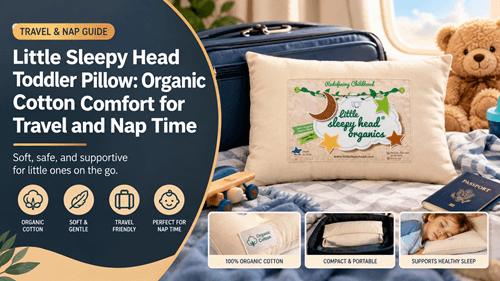
Little Sleepy Head Toddler Pillow is a small 13×18-style pillow intended for older young children, travel, and nap situations where a compact pillow is appropriate. The key buying questions are age suitability, fill height, cover fabric, washing routine, and whether the child’s sleep setting allows a pillow at all.
Parents should not generalize toddler-pillow marketing to infants. Safe-sleep guidance for babies recommends a firm flat sleep surface without pillows or other soft objects. For an older child who is developmentally ready and using a pillow in an appropriate setting, test height and softness rather than assuming a miniature adult pillow is automatically suitable.
How To Evaluate Little Sleepy Head Toddler Pillow For Travel And Naps
Start with the sleep setting. A pillow used on a preschool nap mat has different safety and fit considerations from a pillow placed in an infant crib, car seat, or airplane restraint. Follow the rules of the daycare, hotel, vehicle restraint, and child-safety guidance relevant to the situation.
Next, evaluate loft. Children have narrower shoulders than adults, so a very tall pillow can bend the neck. The head should rest comfortably without being pushed far forward when the child lies on the back or excessively tilted when lying on the side.
Finally, consider cleaning. Travel pillows are exposed to luggage, floors, cars, guest beds, and daycare storage. A removable washable case and a clearly labelled pillow-care routine make repeated use easier.
Cotton Cover, Fill Height, And Portable Sleep Use
Check The Fabric Label, Not Just The Front Claim
An organic cotton toddler pillow should be evaluated by the current product label and any certification information rather than by the word organic alone. Confirm whether the cotton claim applies to the cover, shell, or entire product.
Feel the fabric after washing if the instructions permit prewashing. A cover that becomes rough, shrinks excessively, or twists can change how the pillow fits inside.
Judge Fill By Loft Under The Childs Head
A down-like child pillow fill should compress enough to support the head without lifting it sharply. Pressing the pillow by hand is less useful than observing the head and neck on the actual sleep surface.
Fill that shifts to one side can create uneven height. Fluff and distribute it according to the care directions before each trip or daycare week.
Use Compact Size For Portability, Not Infant Sleep
A 13×18 travel pillow is convenient in luggage because it takes less space than a standard bed pillow. Size alone does not make a pillow safe for a baby or appropriate inside a child restraint.
Pack it in a clean breathable case and keep it separate from shoes or dirty travel items. Confirm the destination provides an appropriate sleep surface.
Match Softness To The Nap Surface
For kids nap pillow softness, consider whether the child naps on a firm mat, small cot, or bed. The pillow should complement that surface rather than compensate for a poor or unsafe sleep setup.
If the child repeatedly pushes the pillow away or sleeps with the head at the edge, the height or warmth may not be comfortable.
Treat Breathability Claims Carefully
A breathable preschool pillow does not override safe-sleep recommendations for babies. The American Academy of Pediatrics advises keeping infant sleep spaces free of pillows and other soft objects.
For older children, fabric comfort and heat still matter, but age-appropriate sleep setup comes first. Follow pediatric guidance if you are unsure when a pillow is appropriate.
Keep Bedtime Familiar During Travel
A familiar portable bedtime comfort item can make a new hotel or family home feel more recognizable to an older child, but keep routines simple and avoid adding multiple new sleep accessories at once.
Use the same pillowcase, bedtime cues, and basic schedule when practical, then wash and dry the pillow according to the label after the trip.
Toddler Travel Pillow Buying Checklist
The pillow should be appropriate for the child’s age, sleep setting, and body size before portability is considered.
| Check | Useful Sign | Reason To Reconsider |
|---|---|---|
| Age and setting | Pillow is appropriate for the child and location | Infant sleep space or prohibited daycare setup |
| Loft | Head stays close to neutral | Neck is sharply flexed or tilted |
| Cover | Soft, removable, easy to wash | Difficult care after travel |
| Size | Fits nap mat and luggage | Too small to stay positioned or too bulky |
| Fill | Evenly distributed after use | Persistent lumps or uneven height |
Test The Pillow During A Supervised Nap Setup
For an older child who already uses a pillow appropriately, a short supervised rest setup can reveal whether the loft and warmth are suitable before the product is packed for daycare or travel.
Parent Pillow Check
- Confirm a pillow is age-appropriate
- Read the daycare or destination rules
- Wash the cover as directed
- Place it on the actual nap surface
- Observe head and neck angle
- Check warmth after several minutes
- Make sure fill stays evenly distributed
- Pack it in a clean case
- Recheck condition after every trip
If you are uncertain whether your child is ready for a pillow, ask the child’s pediatrician and follow current safe-sleep guidance rather than relying on product-age marketing alone.
Keep Pillows Out Of Infant Sleep Spaces
Safe Sleep Comes Before Travel Convenience
For babies, current AAP safe-sleep guidance recommends a firm, flat sleep surface without pillows, blankets, bumper pads, or other soft objects. Do not use a toddler travel pillow to create an infant sleep surface.
Do not place loose pillows behind or under a child in a car seat unless the restraint manufacturer specifically permits that accessory and position. The restraint system must remain correctly fitted.
Choose Little Sleepy Head By Age, Loft, And Care
The Little Sleepy Head Toddler Pillow can be a practical compact option for an older child who already uses a pillow appropriately and needs a familiar item for preschool naps or travel.
Confirm age suitability, test the 13×18-style size and loft on the real sleep surface, and keep the cover clean. For infants or uncertain sleep situations, follow safe-sleep guidance instead of adding a pillow.
Frequently Asked Questions
Is a toddler pillow safe for a baby?
No. Current AAP safe-sleep guidance recommends keeping infant sleep spaces free of pillows and other soft objects.
Is 13×18 a useful travel pillow size for older children?
It can be compact for travel and nap mats, but fit depends on the child’s size and the sleep surface.
How high should a toddler pillow be?
It should not force the head or neck into a sharp angle. A low, comfortable loft is often easier to assess for small children.
Can a toddler pillow go in a car seat?
Only if the car-seat manufacturer permits that accessory and placement. Do not alter the harness or approved fit.
How often should a travel pillow be washed?
Follow the care label and clean it whenever travel, daycare, spills, sweat, or visible soil make washing appropriate.
