
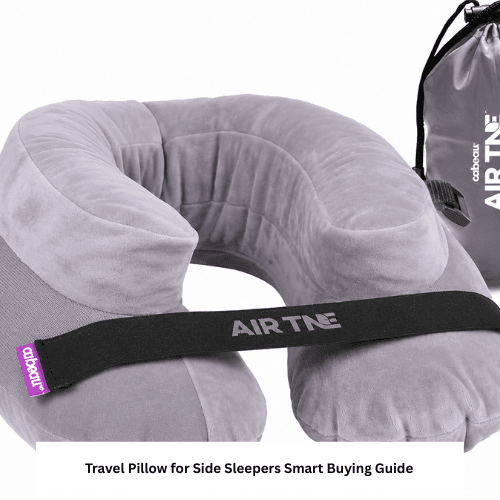
A well-fitted travel pillow for side sleepers should support the head when it naturally leans toward one shoulder without forcing the neck into an uncomfortable angle. The best design depends on shoulder width, neck length, seat position, pillow height, inflation level, and whether the traveler normally rests against a window or sleeps without side support.
Unlike sleeping on a mattress, side sleeping in an airplane seat usually means resting at a slight angle rather than lying fully on one side. The goal is to reduce unsupported head movement while keeping the airway, seatbelt, tray table, and aisle clear.
At inflatable travel pillow, buyers can compare portable designs while checking actual measurements, valve construction, cover materials, cleaning instructions, and return terms.
How a Travel Pillow for Side Sleepers Should Work
A travel pillow for side sleepers should fill the space between the side of the head, neck, shoulder, and seat without pushing the head sharply upward.
A detailed side sleeper pillow buying guide can help travelers compare pillow height, side panels, inflation control, and different seat positions.
The pillow should:
- Support the preferred leaning side
- Allow the traveler to turn the head
- Avoid pressing heavily against the jaw
- Stay in place when the body relaxes
- Fit between the neck and seat
- Allow the seatbelt to remain visible and usable
- Avoid blocking the neighboring passenger or aisle
- Deflate compactly for storage
A pillow that is too low may allow the head to drop. A pillow that is too tall may push the head away from the shoulder and create discomfort.
| Pillow style | Best use | Main advantage | Possible limitation | What to verify |
| Inflatable U-shaped pillow | General neck support | Adjustable firmness and compact storage | Side walls may be too low for some travelers | Inflated height and valve placement |
| High-side inflatable pillow | Leaning toward one shoulder | Fills more space beside the neck | May feel bulky near the jaw | Side-panel height |
| Wrap-style pillow | Travelers who lean consistently to one side | Can provide targeted side support | Fit depends on neck and shoulder shape | Adjustment range |
| Window-seat pillow | Resting against the cabin wall | Uses the wall as an extra support point | Less useful in aisle or middle seats | Seat and wall compatibility |
Measure Your Neck and Shoulder Area
Product labels such as small, standard, or universal may not describe the actual fit.
Measure:
- Neck circumference
- Distance from the shoulder to the base of the ear
- Width across the shoulders
- Normal head-lean angle
- Space between the neck and seat
- Available room inside a hood or high-collar jacket
Compare these measurements with the inflated dimensions.
A travel pillow for side sleepers should not fit so tightly that it restricts normal movement or creates pressure around the throat.
If the product does not provide useful dimensions, verify before buying or select a retailer with a suitable return policy.
Choose the Correct Side Height
The side of the pillow must be high enough to reduce head drop but not so high that it pushes the head in the opposite direction.
Travelers with broader shoulders may need a different shape from travelers with narrow shoulders. Neck length also affects how much space must be filled.
Test the fit while seated upright:
- Relax the shoulders.
- Inflate the pillow partially.
- Lean toward the preferred side.
- Add or release air gradually.
- Check the jaw and ear area.
- Turn the head gently.
- Confirm that breathing remains comfortable.
Do not assume maximum inflation provides maximum support.
Inflation and Firmness Control
An inflatable travel pillow offers adjustable support, but only when the valve allows small changes.
Check whether the valve:
- Opens and closes securely
- Allows controlled air release
- Is positioned away from the face
- Can be used without excessive force
- Has a cap that remains attached
- Can be cleaned
- Includes an internal one-way system
- Has replacement information
Over inflation can create a hard, unstable surface. Slightly reducing the air may help the pillow conform to the shoulder and seat.
A guide to inflatable travel pillow types can help buyers compare U-shaped, wrap, forward-support, and convertible designs.
Neck Support and Head Position
Review a travel pillow for neck support before deciding whether a high-side, wrap, or adjustable inflatable design fits your usual sleeping posture.
Look for support around:
- The preferred side of the neck
- The back of the head
- The chin when needed
- The opposite side when the head changes position
A pillow should support rather than lock the head completely in place.
Travelers with an existing neck condition, recent injury, breathing concern, or medical restriction should seek individual advice from an appropriate healthcare professional before using a restrictive support product.
Long-Flight Comfort
A long-flight travel pillow guide can help travelers plan pillow use with seat setup, clothing, eye masks, earplugs, and storage.
For a long flight pillow, consider:
- How quickly it inflates
- Whether firmness can be adjusted while seated
- Whether the cover becomes warm
- Packed size
- Carrying pouch
- Attachment to luggage
- Cleaning after the flight
- Ease of deflation before landing
Do not use the pillow as a substitute for changing position periodically when movement is permitted.
Follow crew instructions and keep the floor, aisle, and emergency access areas clear.
Setup Before the Trip
Test the pillow at home rather than opening it for the first time after boarding.
Before travel:
- Inflate it fully and inspect for leaks.
- Check the valve.
- Test several firmness levels.
- Sit in a dining or office chair.
- Try both leaning sides.
- Test it with planned travel clothing.
- Wash the cover when permitted.
- Allow every part to dry.
- Pack any storage pouch.
- Keep repair materials only when approved.
The Cabeau inflatable travel pillow listing can help buyers compare an adjustable inflatable design, but verify the current dimensions, materials, included accessories, seller, and care directions.
Conclusion
A travel pillow for side sleepers works best when its height, firmness, and shape fill the space beside the neck without forcing the head upward. Measure the user, consider the seat location, test different inflation levels, and review cleaning, storage, warranty, and return terms before relying on the pillow during a long flight.
FAQ
What shape is best for a side sleeper on a plane?
A high-side inflatable or adjustable wrap design may work well, but the best shape depends on neck length, shoulder width, and seat location.
Should an inflatable pillow be fully inflated?
Not always. Partial inflation may allow the pillow to conform more comfortably to the neck and shoulder.
Is a window seat better for side sleeping?
It can provide another leaning surface, but the gap and cabin-wall shape vary by aircraft.
Can a travel pillow be too tall?
Yes. Excess height may push the head away from the shoulder or create jaw pressure.
How should an inflatable pillow be stored?
Clean and dry it fully, release the air, fold it loosely, and keep it away from sharp or heavy objects.
