
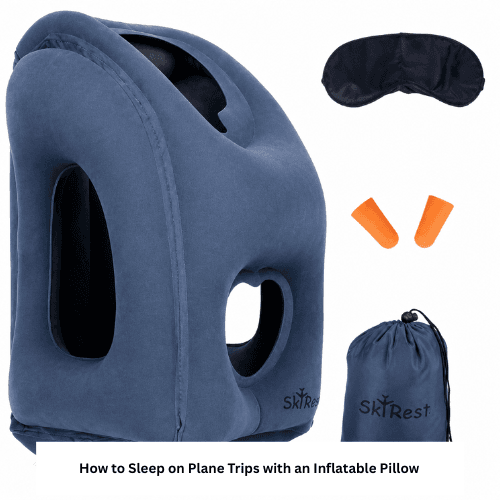
Learning how to sleep on plane trips involves more than placing a pillow behind the neck. The traveler must match the pillow to the seat, adjust the air level, support the head without restricting breathing, and keep the seatbelt, tray table, aisle, and neighboring space clear.
An inflatable pillow can reduce the amount of unsupported head movement while remaining compact inside a carry-on. It cannot guarantee sleep, eliminate jet lag, or treat a neck condition, but a carefully tested setup may make an airplane nap more comfortable.
At inflatable travel pillow, travelers can compare portable support designs while checking valve quality, inflated dimensions, materials, cleaning instructions, and airline compatibility.
How to Sleep on Plane Trips with Better Support
The easiest setup usually begins before boarding.
A long-flight sleep guide can help travelers coordinate pillow support with seat choice, clothing, light control, noise reduction, and carry-on organization.
Prepare by:
- Testing the pillow at home
- Choosing a suitable seat
- Wearing comfortable layers
- Packing an eye mask when helpful
- Keeping headphones or earplugs accessible
- Avoiding a pillow that blocks the aisle
- Confirming that the seatbelt remains usable
- Following all crew instructions
A traveler trying to sleep on plane journeys should aim for a supported, relaxed seated posture rather than recreating a bed.
| Setup | Best suited to | Main advantage | Possible limitation | What to verify |
| U-shaped inflatable pillow | General neck support | Adjustable and compact | May push the head forward | Rear thickness |
| High-side inflatable pillow | Side leaning | Supports one shoulder-to-head gap | May press against the jaw | Side height |
| Wrap-style support | Consistent leaning direction | Reduces side drop with less rear bulk | Can feel warm | Fit and quick removal |
Choose the Right Seat
Window Seat
The window seat may help a traveler lean toward the cabin wall.
Use the inflatable pillow to fill the gap rather than placing the head directly against a hard surface.
Middle Seat
A middle seat provides no wall support. A U-shaped, wrap, or high-side pillow may be more useful.
Keep the pillow inside the seat boundaries.
Aisle Seat
An aisle seat offers easier movement but less protected sleeping space.
Keep the pillow, head, hair, straps, and clothing away from passing passengers and service carts.
Support the Head Without Restricting the Neck
The pillow should keep the head from dropping sharply without holding it rigidly.
Check whether the pillow supports:
- The back of the head
- The preferred leaning side
- The chin when needed
- The opposite side if the traveler changes position
A neck pillow for airplane support can help travelers compare head, chin, and side-support designs.
Stop using the pillow if it creates breathing difficulty, numbness, unusual pain, dizziness, or heavy throat pressure.
Use Travel Accessories Together
A category of airplane comfort accessories can help travelers organize a compact pillow, eye mask, earplugs, blanket, and storage pouch.
Useful combinations may include:
- Inflatable pillow and eye mask
- Pillow and low-profile earbuds
- Pillow and light blanket
- Pillow and layered clothing
- Pillow and lumbar support
Test headphones with the pillow. High side panels can push over-ear headphones upward or press eyeglass arms against the head.
Do not add so many accessories that the seat becomes cluttered.
Preparing for a Red-Eye Flight
A red-eye flight pillow guide can help travelers choose a support level and packing routine for overnight journeys.
Before boarding:
- Inflate and inspect the pillow.
- Keep the valve accessible.
- Place the storage pouch in an easy-to-reach pocket.
- Dress in adjustable layers.
- Keep medication in accordance with professional and airline guidance.
- Set alarms carefully.
- Organize documents before trying to rest.
Avoid testing a new sleep aid, supplement, or medicine solely for a flight without appropriate medical guidance.
Cleaning and Storage
Read the care instructions for both the cover and inflatable chamber.
Do not machine wash the air chamber unless the product specifically allows it.
Clean the valve carefully and prevent dirt from entering the opening.
Dry the pillow fully before deflation and storage.
Store it:
- Inside its pouch
- Away from sharp objects
- Away from excessive heat
- Outside damp luggage
- Without heavy items pressing on the valve
The Skyrest inflatable airplane pillow listing can help travelers compare a forward-rest design, but verify the current dimensions, airline suitability, materials, seller, and cleaning instructions.
Warranty, Returns, and Support
Check:
- Trial period
- Hygiene-related return rules
- Leak warranty
- Valve coverage
- Seam coverage
- Replacement covers
- Repair kits
- Delivery tracking
- Missing-part support
Inspect and test the pillow immediately after delivery.
Do not wait until the trip is near if the return window may close.
Conclusion
To sleep on plane journeys more comfortably, select an inflatable pillow that matches the seat, neck measurements, and preferred resting position. Test it before departure, use partial inflation when appropriate, keep safety equipment accessible, and clean and inspect the pillow after every trip.
FAQ
Is an inflatable pillow good for long flights?
It can provide adjustable support while taking up little luggage space, but fit and design matter.
Should I use maximum inflation?
Not necessarily. Partial inflation may create a softer and more stable fit.
Can I attach a pillow to the airplane seat?
Only when the airline and product instructions permit it. Do not attach anything that interferes with safety equipment.
Is a window seat best for sleeping?
It can provide a leaning surface, but a middle or aisle seat may suit travelers who value easier movement.
How should I clean the pillow after a flight?
Wash the cover and wipe the air chamber according to the care label, then dry every part fully.
