
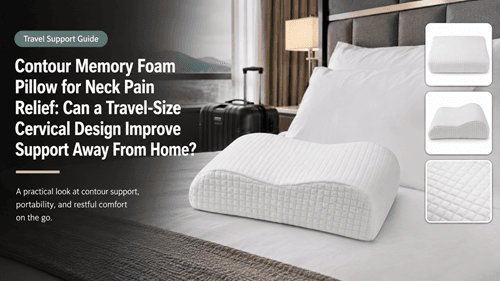
Contour Memory Foam Pillow for Neck Pain Relief is worth judging around one practical question: whether a smaller cervical contour can reproduce familiar neck support in hotels and other away-from-home sleeping environments without overpromising pain relief. That is more useful than treating the product name or feature count as proof of comfort. For travelers who prioritize structured cervical support when sleeping away from home, the best result comes from matching the accessory to the seat, sleeping position, luggage plan, and the length of the trip.
This guide focuses on what can be checked before purchase and during a home trial. It does not assume that one travel product works for every body or every route. The current listing for Contour Memory Foam Pillow for Neck Pain Relief should be used to confirm dimensions, materials, included pieces, care directions, and any manufacturer updates before ordering.
How To Evaluate Contour Memory Foam Pillow For Neck Pain Relief For Real Travel
The Contour Memory Foam Pillow for Neck Pain Relief should first be evaluated in the position where it will actually be used. A soft hand-feel in a product photo tells very little about how the accessory behaves after twenty or forty minutes of seated pressure. Recreate the likely posture at home, include headphones or a jacket if you normally travel with them, and pay attention to pressure points rather than waiting until the trip to discover them.
The key measurement is not pillow width but loft under the neck and head. Side sleepers, back sleepers, shoulder width, mattress firmness, and existing pain patterns all change the required contour. This kind of fit check is especially important because airline, train, bus, car, and hotel seats create different gaps around the neck, shoulders, lower back, or legs. A design can be comfortable in one environment and awkward in another without being defective.
Portability deserves the same level of scrutiny. The accessory has to move through security, connections, boarding, and arrival, not merely fit inside a suitcase at home. Think about where it will live before boarding, how quickly it can be reached, and whether it can be repacked without taking over a neighboring seat or clean floor space.
Support, Fit, And Packability Details
Support Or Function
A travel-size cervical cushion should preserve enough contour height to support the neck while still fitting practical luggage limits. When comparing a travel size cervical cushion, use the destination as supporting context and then return to the actual product specifications for the final decision.
Packing And Access
A contour can help fill the natural gap under the neck, but the wrong height can increase flexion or extension instead of improving comfort. When comparing a contoured neck support pillow, use the destination as supporting context and then return to the actual product specifications for the final decision.
A useful feature should reduce friction in the travel routine. If it takes both hands, a large clean surface, or several minutes to set up, its advantage can disappear in a busy cabin or station.
Comfort During Longer Use
The word orthopedic does not guarantee a therapeutic outcome; travelers should judge dimensions, firmness, and whether their clinician has recommended a particular setup. When comparing a portable orthopedic headrest, use the destination as supporting context and then return to the actual product specifications for the final decision.
Cleaning And Maintenance
Small memory foam designs pack more compactly than full-size bedroom pillows but still need time to recover after compression. When comparing a small memory foam cervical pillow, use the destination as supporting context and then return to the actual product specifications for the final decision.
Seat Or Sleep-Surface Compatibility
A portable pillow can create a familiar surface when hotel pillows are too high or soft, especially when used on top of a firm mattress. When comparing a hotel neck support accessory, use the destination as supporting context and then return to the actual product specifications for the final decision.
Seat and sleeping surfaces change support geometry. Recheck the setup when switching from aircraft to car, train, campsite, or hotel instead of assuming the same orientation will work everywhere.
Travel-Day Practicality
Persistent neck pain needs appropriate assessment; general neck-pain guidance emphasizes staying active and seeking help for concerning symptoms. When comparing a ergonomic sleeping travel cushion, use the destination as supporting context and then return to the actual product specifications for the final decision.
Practical Comparison Checklist
Use the table as a pre-purchase and pre-trip check. The goal is to turn broad marketing language into something you can actually test.
| Area | What to Assess | A Useful Result |
|---|---|---|
| Back sleeping | Neck curve and head cradle | Chin remains neutral rather than tipped upward |
| Side sleeping | Shoulder-to-head gap | Head does not drop toward mattress |
| Packing | Foam compression | Pillow recovers before bedtime |
| Hotel use | Mattress and base pillow | Setup can be adjusted without stacking too high |
| Pain response | Comfort trend | No increase in radiating pain or neurologic symptoms |
Run A Realistic Pre-Trip Fit Test
Test the pillow on a mattress similar in firmness to what you normally use. Try back and side sleeping separately, and note whether the highest and lowest contour edges change neck angle in a comfortable way.
Do the trial with the bag, clothing, headphones, or bedding you expect to use on the trip. Small conflicts—such as a high pillow edge touching headphone cups or a storage pouch that does not fit the chosen pocket—are much easier to solve at home than after boarding.
Pre-Trip Checklist
- Compare loft with your home pillow
- Test both contour orientations
- Avoid extreme compression unless approved
- Give foam time to recover
- Use a clean washable cover
- Do not stack several high pillows
- Stop if symptoms worsen
- Keep medical advice separate from product marketing
Balance Comfort Against The Main Tradeoff
For travelers who prioritize structured cervical support when sleeping away from home, this design is easiest to justify when its primary function solves a recurring problem and the accessory is convenient enough to be carried on most relevant trips. If it stays at home because it is awkward to pack, difficult to clean, or too specialized, a simpler alternative may deliver more value.
Travel-size cervical pillows improve consistency but consume more luggage space than inflatable designs. Compressing foam too aggressively may also delay recovery when the traveler reaches the hotel. Compare that compromise with the alternatives you already own. The right question is not whether the product has more features, but whether its strongest feature improves the specific trip often enough to justify cost and luggage space.
Safety and Comfort Boundary
Seek medical care for severe neck pain after injury, weakness, numbness, persistent pins and needles, severe headache, fever, or other concerning symptoms. A pillow should not be presented as a cure for neck pain.
A Practical Take On Contour Memory Foam Pillow For Neck Pain Relief
The Contour Memory Foam Pillow for Neck Pain Relief makes the most sense when the traveler can explain exactly which problem it solves, where it will be stored, and how it will be cleaned. Test the core function in realistic conditions, then judge secondary features only after fit and usability are satisfactory.
Before buying, verify the current product listing and return terms, because materials, bundles, dimensions, and accessories can change. A short home trial and a clear packing plan usually reveal more than a long feature list.
Frequently Asked Questions
Can a cervical travel pillow cure neck pain?
No. A pillow can influence sleeping position and comfort, but persistent or severe neck pain should be assessed by a healthcare professional.
Is a smaller cervical pillow enough for side sleeping?
It depends on shoulder width, mattress firmness, and pillow loft. The head should remain reasonably aligned with the spine.
Can memory foam be compressed in luggage?
Some products can be compressed temporarily, but follow the manufacturer's instructions and allow enough time for full recovery.
Should I use the high or low contour edge?
Use the orientation that keeps the neck comfortable and the chin neutral; the correct side varies by body size and sleeping position.
What if a hotel mattress is softer than my mattress at home?
A softer mattress lets the shoulder sink more, which can change the pillow height you need. Reassess alignment instead of assuming the same setup.
